Motivation
At some point during one of my productive doomscrolling evenings, on YouTube specifically, I came across a video produced in November 2024 by Marcello Ascani featuring a pizzaiolo who moved to San Francisco, and was at the time working for a company producing Napolitan frozen pizzas in the Bay area. The original video can be found here.
The business model showcased in the video was baking fresh Napolitan pizzas just outside of the city, freeze them, and then ship them to around 100 Whole Foods locations in the area, where they were sold at around $10 a piece.
Living in Norway, where frozen pizza is one of the most consumed foods (but alas not because of exceptional quality) this video sparked curiosity in the form of "what if I could do it myself, and have a stack of delicious and cheap homemade frozen pizzas at any given time rather than buying the crap at the store?".
Not that I would buy frozen pizzas anyway. I am a true patriot 🇮🇹🤌.
Background
Baking is not a trivial process, and it shares a lot more similarities to chemistry than cooking does. And, believe it or not, chemistry was one of my least favorite subjects in highschool. Probably one of the contributing factors pushing me towards mathematics and informatics rather than physics and engineering.
While preparing for this project I did a deep dive into the theory of flour types and baking — which we are soon going to cover — and contacted a couple of industries dealing in flour milling and frozen pizzas production. The summary of this explorative search follows.
Types of flours and yeast
Not all flour is the same, and this is obvious when facing the flour shelf of a well-stocked grocery store. Some flours are sold for breadmaking, others for focaccia, some for cakes and shortbreads. The difference lies not only in the grain type and origin, but also in the milling procedure, and they can be quantified and accurately measured. The characteristics of flours can be inferred by metrics such as protein content, W-value, P/L ratio, water absorption, and ash content just to name a few.
Several countries introduced naming conventions with associated requirements, and have strict regulations on how to name them. In Italy, just to name a country, these types can be defined as tipo 00, tipo 0, tipo 1, tipo 2, and integrale. Other countries may follow different naming conventions.
Protein content
This is the value that is easiest to find as a retail consumer. By law it needs to be reported on every package of flour which is sold. It typical ranges between 9g and 14g per 100g of product. This is usually referred to as the strength of the flour, as the protein contained in the flour is usually gluten-forming proteins.
The rule of thumb is to pick an 11-12.5% for Napolitan pizza and 12.5-14% for long fermentations.
W-value
The W-value measures the required energy to deform the dough — either resisting to manipulation or resisting to the dough raising — thus making it a good proxy for gluten strength. The alveograph test consists of inflating a disk of dough, making it into a bubble, until it bursts, while measuring the pressure for the first deformation and the total volume of air that is needed to rupture the glutinic mesh.
Typical ranges and common uses are:
- < 170 : weak (cookies and shortbreads)
- 180 - 270 : medium (direct doughs, short-medium fermentations)
- 280 - 350 : strong (long fermentations)
- > 350 : very strong (panettone, biga for multistep doughs, very high hydration doughs)
The W-value is measured in a lab test using the Chopin's alveograph test, and it is not a metric that is legally required to be reported. Approximate ranges can be inferred if the flour is sold as a specific type, but specific values are often found only on more premium flours.
For more refined flours, with a minimal content of bran, the W-value correlates well with the protein content. But for other types of flours, for example wholegrain or if durum wheat or other grains are mixed in, the protein content does not correlate as directly with the W-value as measured by the alveograph test. Moreover, the W-value as a proxy for gluten strength loses significance in these cases and should be disregarded.
P/L ratio
The P/L ratio measures the ratio between tenacity (P) and extensibility (L) and it is also measured through the alveograph test. The P value is the pressure to first deformation, while the L value is the total volume of air that the dough can handle before bursting — which corresponds to how much it can extend before rupturing.
Ash content
The ash content is not a measure of how much ash there is in flour, but rather a measure of the mineral content. It has gotten this name due to the procedure with whom it is measured: a sample is burned and minerals are then measured in the ash residue that is left behind after combustion has taken place.
As the minerals are mostly contained in the bran of the wheat, the ash content is a good indicator of how much of the bran has made it into the flour — menaing how little refined the flour is.
In Italy the ash content is regulated by law by the name of the type of the flour, which can be tipo 00, tipo 0, tipo 1, tipo 2, and integrale. In other countries other classifications can be in place, or it can happen that no classification at all is used. In these cases it can be harder to determine the ash content of the flour you are buying.
I have attempted to put together a table of some of the flours for sale at retail grocery stores in Norway, as well as online at the specialty store "Oluf Lorentzen". Most of the technical specification of the flour is available online on the websites of the respective producers. I have also contacted Regal flour, which is one of the main brands for retail shoppers in Norway, for information regarding their lines of flour. The price was reported as the minimum "bulk price" for orders of a maximum of 5kg, taking advantage of "quantity discounts" such as 3x2 offers but not seasonal or temporary discounts.
| Flour | Protein % | W-value | P/L | Price (NOK/kg) |
|---|---|---|---|---|
| Regal Sifted Wheat Flour | 12% | ? | ? | 14.95 |
| Molini Pizzuti Tipo 00 | 10% | 200 | ? | 31.27 |
| Regal Pizzamel | 12% | ? | ? | 26.50 |
| La Molisana Tipo 00 | 11% | 250 | ? | 30.80 |
| Dallari Tipo 00 | 10.2% | 240-270 | ? | 31.27 |
| Caputo Pizzeria | 12.5% | 260-280 | 0.50-0.60 | 41.27 |
| Regal Tipo 00 | 13% | 260-300 | ? | 36.50 |
| Caputo Nuvola | 12.5% | 270-290 | 0.50-0.60 | 54.60 |
| Caputo Saccorosso | 13% | 300-320 | 0.50-0.60 | 51.20 |
| Caputo Manitoba oro | 14% | 360-380 | 0.45-0.55 | 43.93 |
| Caputo gluten-free | 1% | ? | ? | 161.00 |
Choice of toppings
Toppings need to be able to preserve their quality when frozen. Sauces, cheeses, roasted vegetables, and cooked meats (pepperoni, 'nduja, bacon …) are all excellent choices as toppings as quality is mostly preserved when undergoing the freezing process. Fresh ingredients and cold cuts, such as rucola, cherry tomatoes, and prosciutto crudo, completely lose their profile when undergoing the freezing and reheating process.
Freezing / cold blast process
From what I gathered from a quick literature review, it appeared that most of the available research covered (raw) doughs and parbaked (partially baked) products. Parbaking is probably the best way to prepare the pizza dough, but it would deprive the pizza of its classic Napolitan-style crust. I wanted a finished product that was possible to prepare in the oven straight from the freezer in approximately 10-12 minutes.
Research on frozen doughs and parbaked products shows that the type and strength of flour make a big difference in how well the pizza base survives freezing and reheating. Stronger flours with higher gluten content, which correspond to higher W-values, tend to retain more gas and structure after thawing, leading to better texture 1. For home use, this means preferring a strong flour.
If the dough is fully baked — as in our case — freezing can still alter water distribution: ice crystals in the crumb can cause slight dryness, while moisture migration may soften the crust 2. Cold blasting is often used in industrial production, as it drops the temperature of the food quickly, freezing it to the core within minutes. Because freezing happens so fast, the liquids form smaller crystals than they normally would in a regular freezer, locking in structure, texture, and aroma. Unfortunately, this is out of reach for most homecooks. Even without a blast chiller, minimizing the time it takes for the dough to freeze — for example by using thin metal trays — helps protecting the texture and flavor.
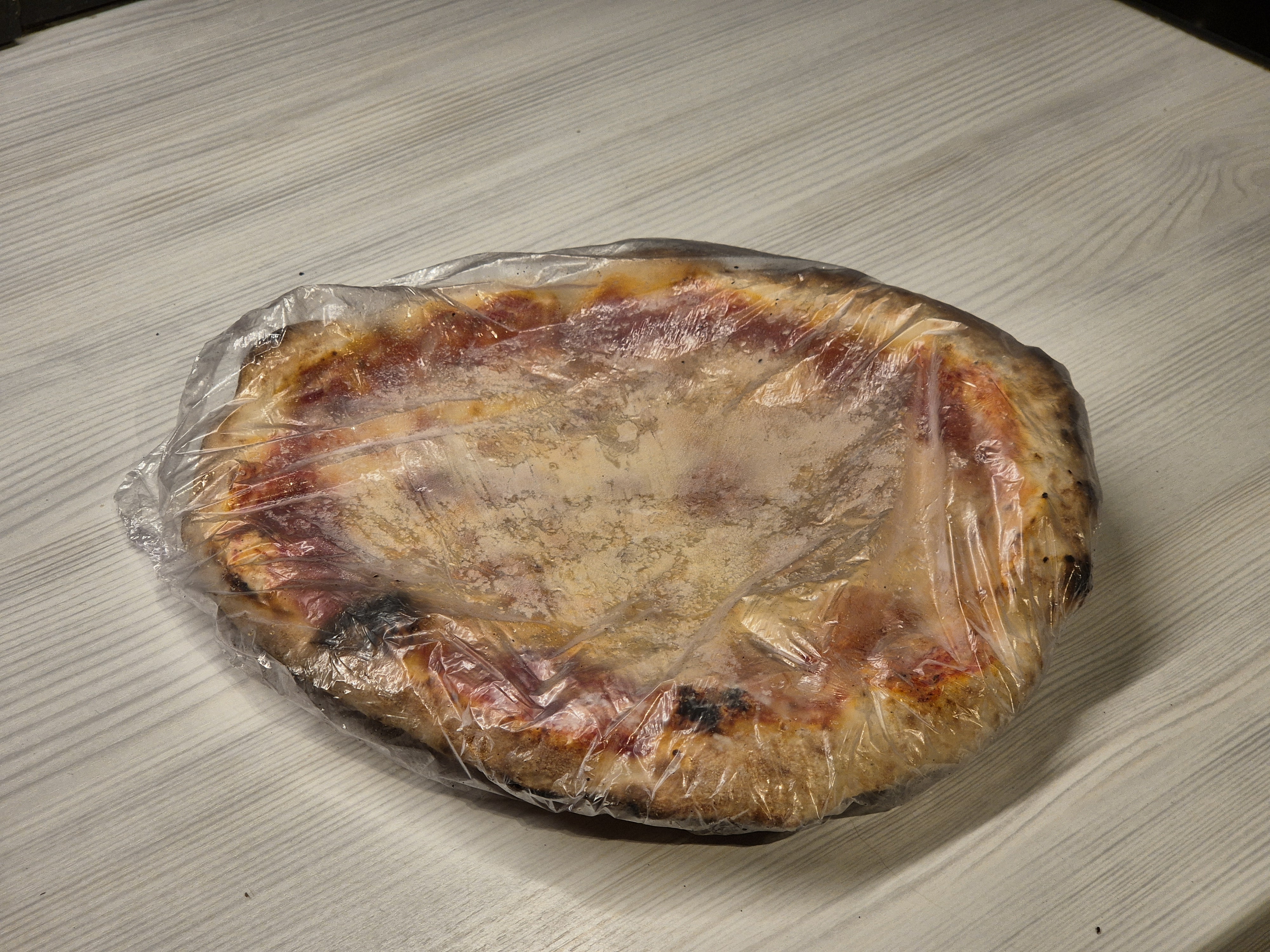
From my personal experience a regular freezer is good enough to obtain quite decent results. I have opted to wrap the pizzas in a layer of cling film to avoid freeze burns, which would dramatically reduce the quality of the final product. It is important to let the pizzas cool down before freezing, in order to minimize condensation and raising the internal temperature of the freezer. Optionally, after the pizzas have been frozen solid, it is possible to double wrap them in a second layer of cling film to further decrease the risk of freeze burns when stored for longer periods of time.
My first attempt
The recipe I have opted to use is the following, which has a yield of 4 pizzas:
| Ingredient | Quantity | Details |
|---|---|---|
| Flour | 600 g | Caputo Pizzeria flour |
| Water | 360 g | |
| Oil | 20 g | Extra-virgin olive oil |
| Salt | 14 g | |
| Yeast | 1.5 g | Caputo dry yeast |
Napolitan pizza dough does not usually contain oil, but oil is rather used as a topping which is added to the pizza just before going into the oven. However, a bit of extra virgin olive oil makes for a softer and richer dough, which I prefer. It also has the added benefit of makin the dough easier to handle.
After using a kitchen mixer, and giving a final folding by hand, I left the dough to rest and start the raising process at room temperature for approximately 4 hours before moving it in the fridge. This slows down the raising process allowing for better timing.
Approximately 4 hours before the pizza is to be baked, I take the dough out of the fridge and divide it into the 4 portions that will be then used to make the pizzas. After folding the dough a second time, and another 3.5h at room temperature, I like to move the portions again in the fridge to reduce the dough temperature, making the dough a bit stiffer and easier to work.
I then baked the pizza in a gas-powered pizza oven (cozze 13") until done, and left it to cool down on the bench before wrapping it in cling foil. As I do not have a chill blaster, I used my freezer to freeze and store the pizza.
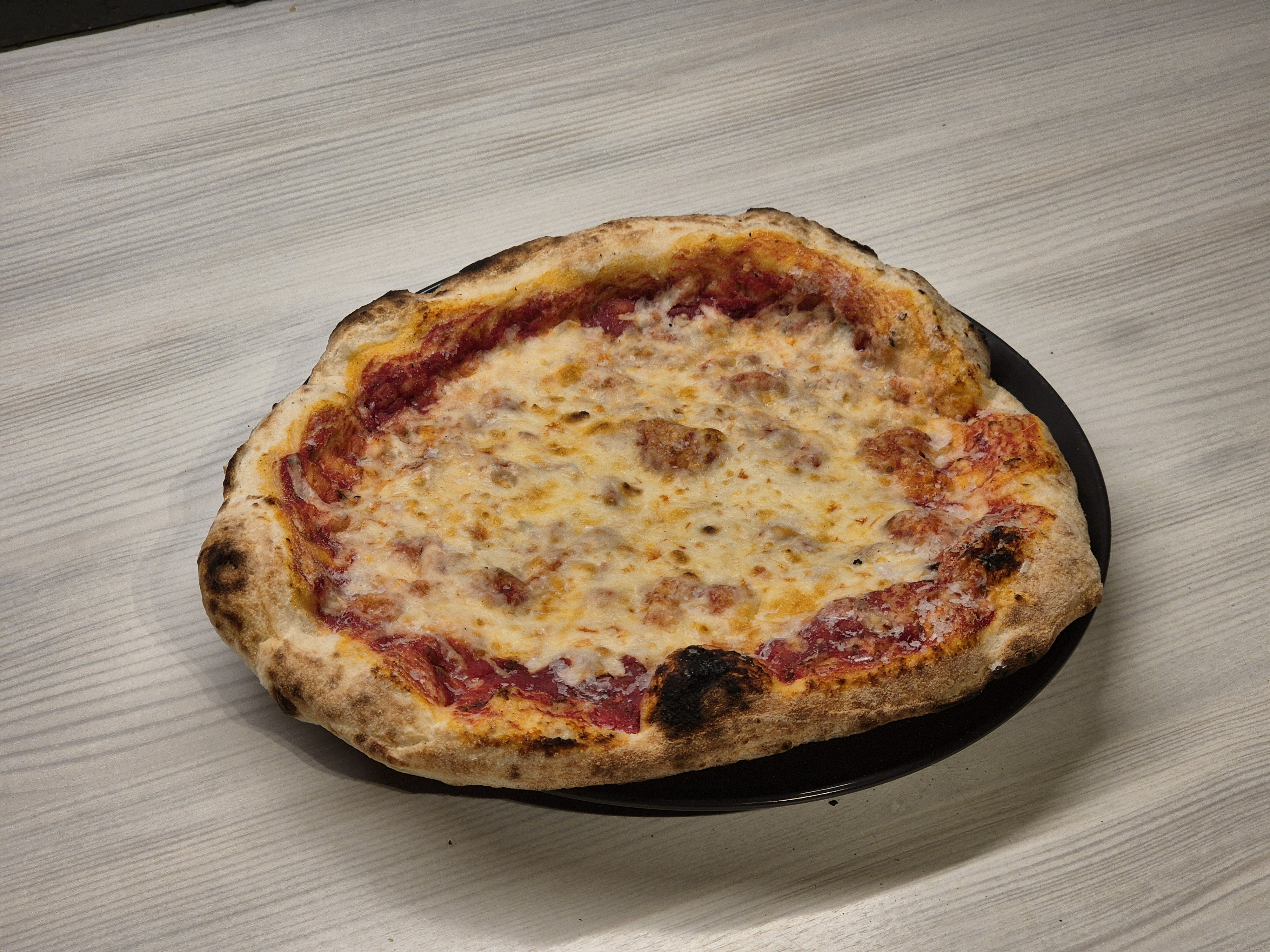

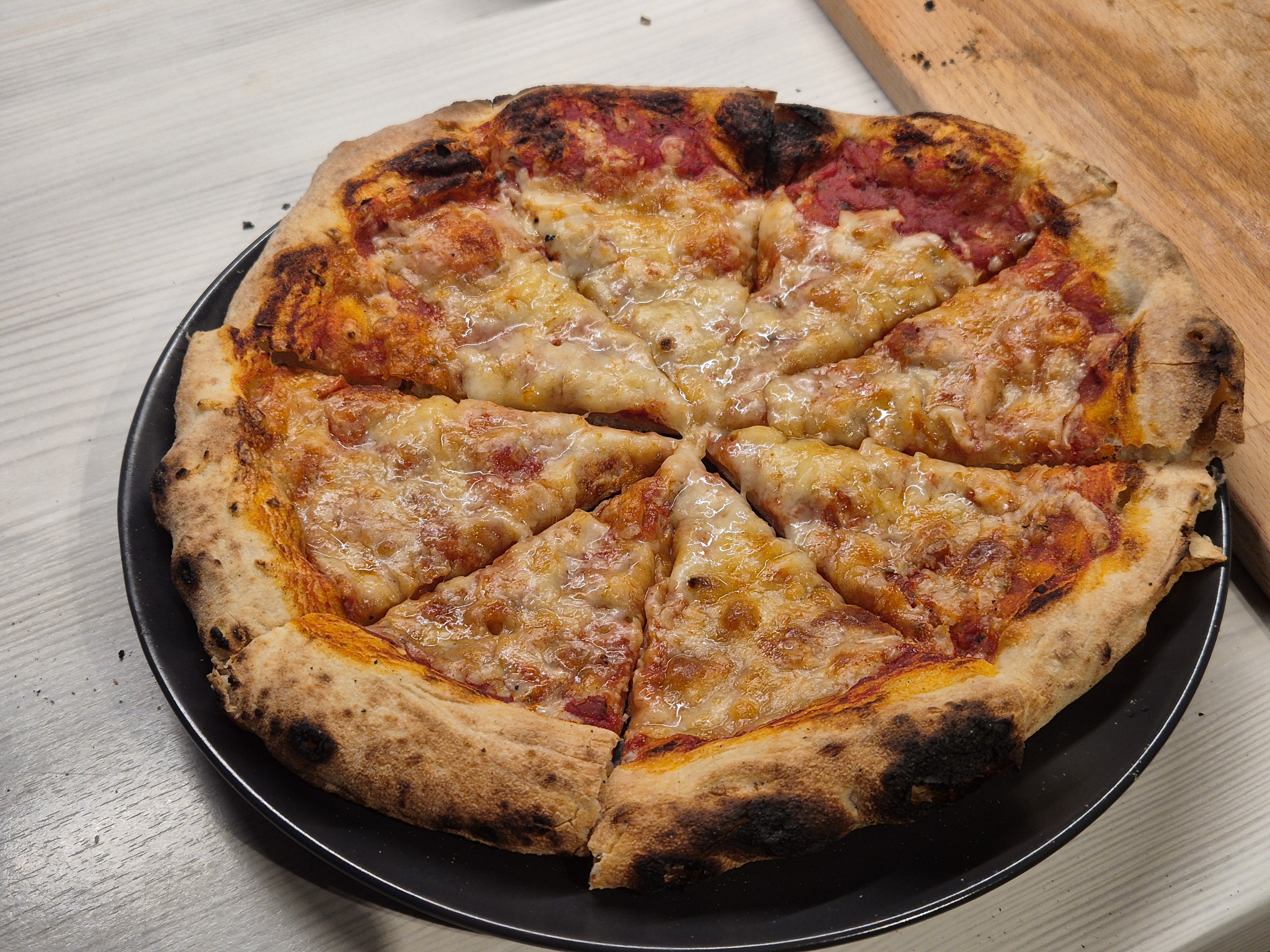
After a few days in the freezer, it was the moment of the truth: I took a pizza out of the freezer, preheated the oven at 200°, and reheated for about 10 minutes.
All in all the pizza was delicious, but different than a fresh one by a mile. In particular the cheese on top was maybe a bit overcooked, and the crust was dry and crunchy in a slightly unpleasant way. So I would call it a success with a discrete margin of improvement.
My second attempt
For my second attempt I modified two steps in the procedure:
- Tried swapping "Caputo Pizzeria" for "Caputo Nuvola";
- The toppings are now added AFTER an initial baking;
- Oil is added to the crust before freezing to prevent a dry crust.
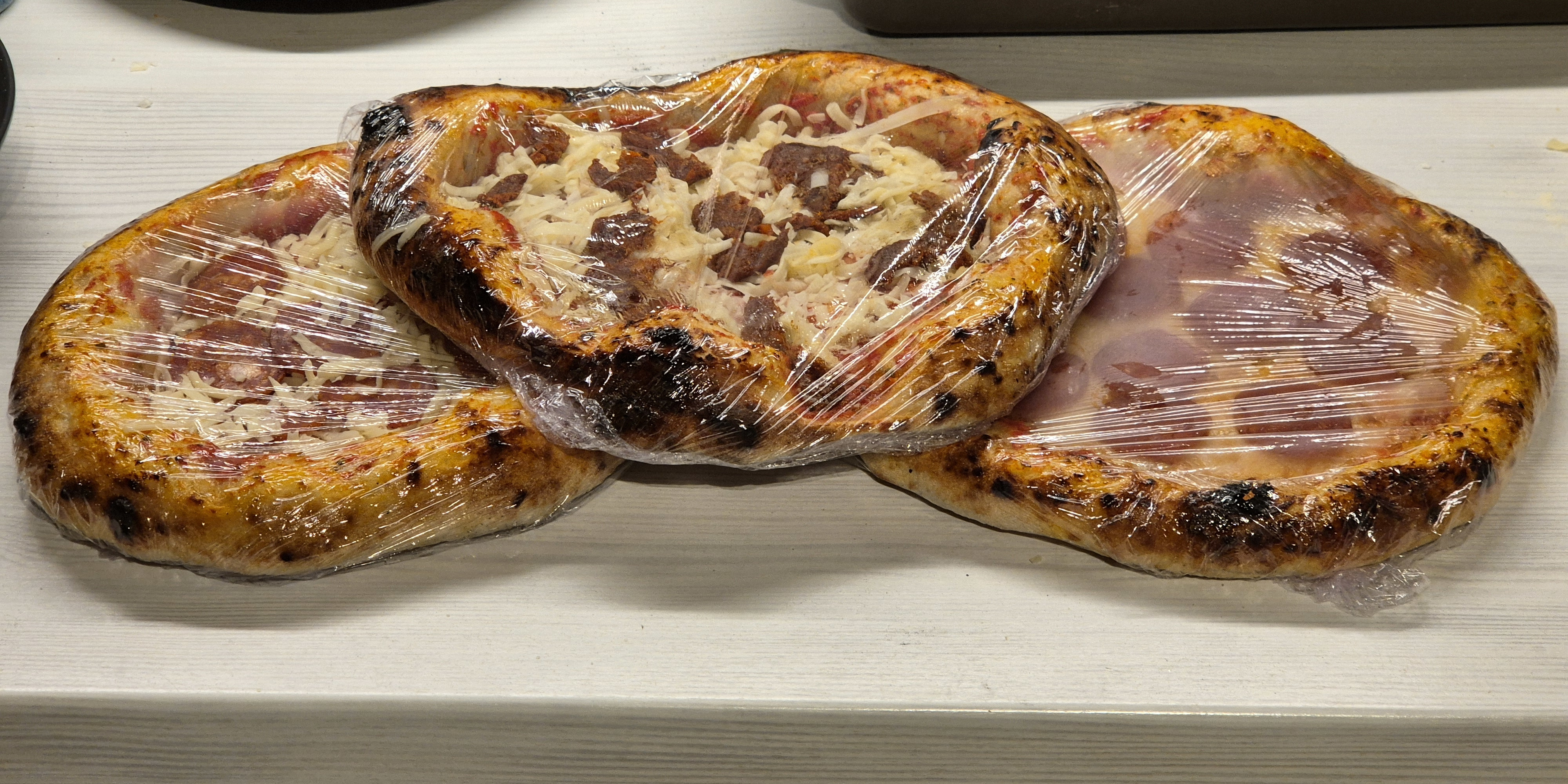
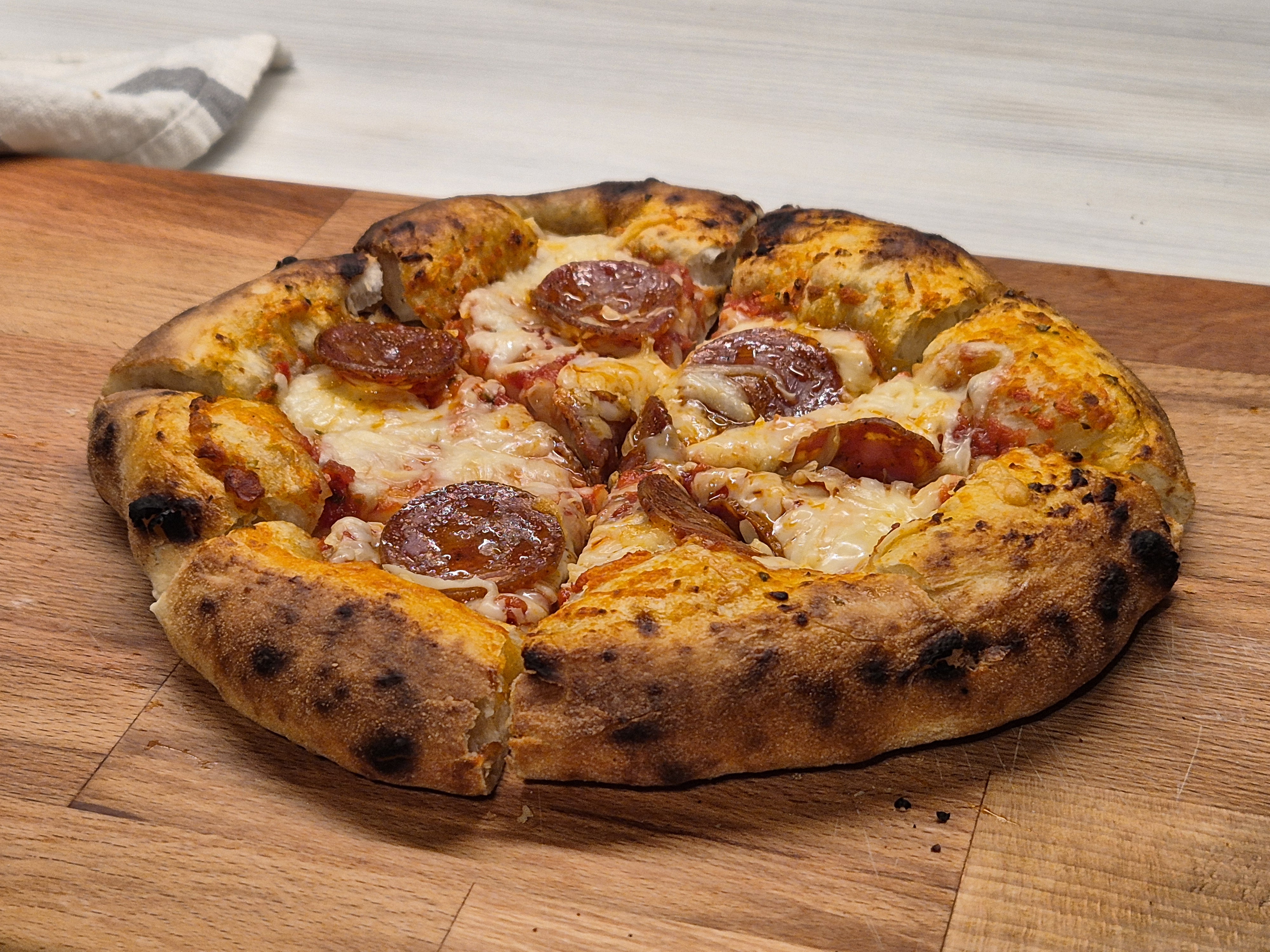
These slight adjustments made a big difference. The pizza came out of the oven with cheese that was now hot but not "lava-like" hot, and the crust was less dry and crunchy, although still quite different from the fresh version.
The change of flour was not really noticeable.
Conclusions
When it comes to quality of the final product there is no comparison: the homemade frozen pizza beats the commercial ones hands down. Not only do they taste and feel better, but can be highly customizable allowing for a larger range of possibilities.
Let us now analyze the cost. To estimate it I will use the prices available to the retail customer in the Norwegian market as of November 2025.
Estimating the propane usage is not trivial, as it depends on the pre-heating time, the number of pizzas made per batch, and the speed of the pizzaiolo. By a back-of-the-envelope calculation I approximate a 5kg canister to be good for around 75 pizzas. Such a canister can be refilled completely for 269 NOK. Cost estimates assuming we are using all the ingredients in the most efficient way possible.
| Ingredient | Quantity | Cost per pizza (NOK) |
|---|---|---|
| Flour | 150 g | 6.19 |
| Water | 90 g | 0.00 |
| Oil | 5 g | 1.80 |
| Salt | 3.5 g | < 0.01 |
| Yeast | 0.75 g | 0.60 |
| Tomato sauce | 100 g | 1.80 |
| Cheese topping | 70 g | 9.63 |
| Gas | 3.60 | |
| Total | 23.62 NOK |
Comparing it to the Norwegian national treasure Grandiosa pizza and the cheapest option First Price margherita — which sell at 59.90 NOK on oda.no and 29.90 NOK at the grocery chain Meny respectively — it seems like it pays off to bake homemade pizzas, also from a cost perspective.
References
-
Inoue, Y., and W. Bushuk. “Studies on Frozen Doughs. II. Flour Quality Requirements for Bread Production from Frozen Dough.” Cereal Chemistry, vol. 69, no. 4, 1992, pp. 423-428. ↩
-
Bárcenas, M. E., et al. “Effect of freezing and frozen storage on the staling of part-baked and full-baked bread.” Journal of Food Engineering, vol. 64, 2004, pp. 307–315. ↩