Research
Data-driven discovery of equivariant PDEs via multigraph isomorphisms
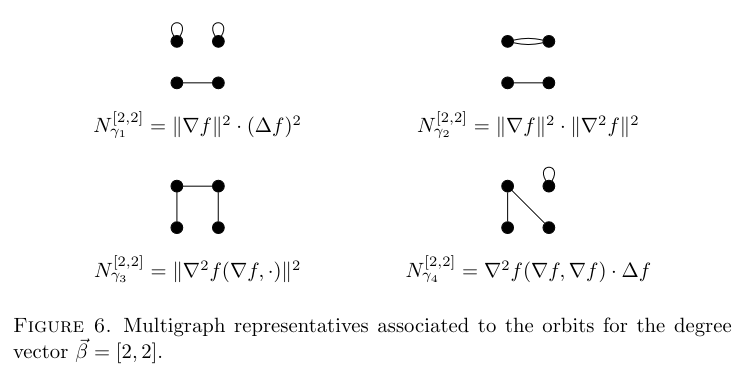
A fundamental challenge in PDE-learning, which is the problem of deducing a governing equation from possibly noisy data, is understanding which differential operators can arise as candidates when the underlying domain carries geometric structure. On simply connected spaces of constant curvature (Euclidean space, sphere, hyperbolic plane) a natural constraint is that the operators should be equivariant under the action of the full isometry group, meaning their form is preserved under all symmetries of the space.
In our work [1], we provide a complete classification of nonlinear operators on such spaces that are equivariant under the isometry group and can be expressed as polynomials in linear differential operators. We show that the classifying space for such operators can be realized concretely as the vector space spanned by equivalence classes of multigraphs, providing a combinatorial and geometric structure to what was previously an implicit family of operators.
Beyond the classification itself, we illustrate how this multigraph representation can be used to discover non-trivial linear dependence relations between nonlinear differential operators that depend on the dimension of the manifold. We also extend the framework to operators equivariant under the identity component of the isometry group and to isometry groups of sub-Riemannian model spaces, broadening the applicability of the results to settings relevant to geometric analysis and data-driven PDE discovery.
In [2] we benchmark a library of differential operators deduced from this theoretical results against known methods within PDE discovery such as [3] and [4], empirically showing that libraries built under these assumptions generally outperform classical methods, with the advantage being most pronounced when the noise itself breaks rigid-motion symmetry (e.g., radially or axially varying noise).
[1] Ballerin, F., & Grong, E. (2026). Equivariant nonlinear partial differential operators on constant curvature spaces. arXiv:2605.16847.
[2] Ballerin, F., & Grong, E. (2026). Discovering PDEs equivariant under rigid motions. arXiv:2608.08913.
[3] Rudy, S. H., Brunton, S. L., Proctor, J. L., & Kutz, J. N (2017). Data-driven discovery of partial differential equations. Science advances, 3(4), e1602614.
[4] Messenger, D. A., & Bortz, D. M. (2021). Weak SINDy for partial differential equations. Journal of computational physics, 443, 110525.
SO(3)-Equivariant Neural Networks
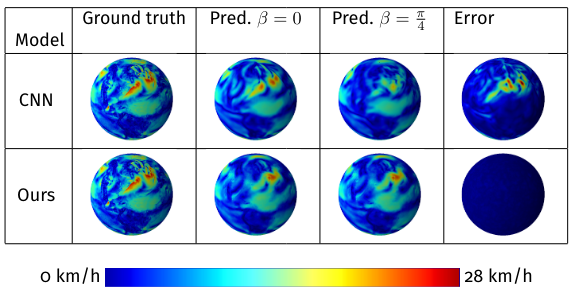
Analyzing scalar and vector fields defined on the sphere — such as temperature, pressure, or wind velocity on Earth — poses fundamental challenges for standard deep learning architectures. A natural requirement is that a model respects the symmetries of the domain: predictions should be equivariant with respect to rotations of the sphere, and should also respect the intrinsic transformation properties of the signals themselves (e.g., a vector field rotates along with the sphere). [1]
A class of equivariant architectures has emerged that processes spherical signals via group convolutions in Fourier space with respect to the three-dimensional rotation group \(SO(3)\). [2,3,4] However, these models impose strong constraints on the admissible convolution kernels and nonlinearities in order to preserve the desired equivariance properties, significantly limiting their expressivity.
In our work [5], we introduce a deep learning architecture for scalar and vector fields on the sphere that lifts these restrictions, enabling a richer class of convolution kernels and activation functions. The key insight is to treat such signals as general functions on \(SO(3)\), allowing general convolution kernels and activation functions on \(SO(3)\) while imposing equivariant restrictions as orthogonal projections to the class of spin-equivariant functions at the end of each neural layer. Experiments demonstrate that our architecture generally outperforms standard CNNs and often matches or exceeds the performance of spherical CNNs under comparable conditions.
[1] Bronstein, M. M., Bruna, J., LeCun, Y., Szlam, A., & Vandergheynst, P. (2017). Geometric deep learning: Going beyond Euclidean data. IEEE Signal Processing Magazine, 34(4), 18–42.
[2] Cohen, T. S., Geiger, M., Koehler, J., & Welling, M. (2018). Spherical CNNs. arXiv:1801.10130.
[3] Esteves, C., Allen-Blanchette, C., Makadia, A., & Daniilidis, K. (2020). Learning SO(3) equivariant representations with spherical CNNs. International Journal of Computer Vision, 128(3), 588–600.
[4] Esteves, C., Slotine, J., & Makadia, A. (2023). Scaling spherical CNNs. ICLR 2023.
[5] Ballerin, F., Blaser, N., & Grong, E. (2025). SO(3)-equivariant neural networks for learning from scalar and vector fields on spheres. arXiv:2503.09456.
Neurogeometry of the visual cortex
This project is based on previous work by Citti and Sarti [1] and subsequent works by Boscain et al. [2,3,4] to develop new procedures and algorithms for PDE-based image restoration.
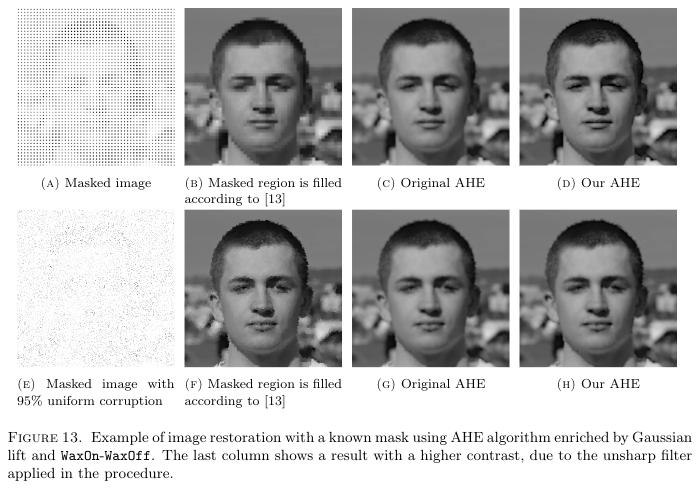
Equipping the rototranslation group \(SE(2)\) with a sub-Riemannian structure inspired by the visual cortex V1, we propose algorithms for image inpainting and enhancement based on hypoelliptic diffusion [5]. We innovate on previous implementations of the methods by Citti, Sarti, and Boscain et al. by proposing an alternative that prevents fading and is capable of producing sharper results in a procedure that we call WaxOn-WaxOff. We also exploit the sub-Riemannian structure to define a completely new unsharp mask using \(SE(2)\), analogous to the classical unsharp filter for 2D image processing, with applications to image enhancement. We demonstrate our method on blood vessel enhancement in retinal scans.
In addition to the theoretical and algorithmic contributions, we developed an open-source implementation of the proposed methods, available on GitHub.
[1] Citti, G., & Sarti, A. (2006). A cortical based model of perceptual completion in the roto-translation space. Journal of Mathematical Imaging and Vision, 24(3), 307–326.
[2] Boscain, U., et al. (2012). Anthropomorphic image reconstruction via hypoelliptic diffusion. SIAM Journal on Control and Optimization, 50(3), 1309–1336.
[3] Boscain, U., et al. (2014). Hypoelliptic diffusion and human vision: A semidiscrete new twist. SIAM Journal on Imaging Sciences, 7(2), 669–695.
[4] Boscain, U., et al. (2018). Highly corrupted image inpainting through hypoelliptic diffusion. Journal of Mathematical Imaging and Vision, 60(8), 1231–1245.
[5] Ballerin, F., & Grong, E. (2023). Geometry of the visual cortex with applications to image inpainting and enhancement. arXiv:2308.07652.